I dissolved the yeast first, place in the jug first. Then I semi-dissolve the sugar in the juices, and place that in the jug. Fill the rest of the jug with water to an inch below the neck of the...Read More » »
Dear
Kraus,
I have a batch of peach wine and a batch of pear wine in 5 gallon
glass jugs ready to bottle. Both need to be sweetened at
bottling time to bring out more of the fruit flavor. Please
explain to this rookie exactly how you sweeten the wine as you
bottle it. Do you add the sugar/water solutions to each
bottle or do you add to the 5 gallon glass jugs, stir, and then
bottle?? Same question on how to add the chemicals to prevent
re-fermentation and oxidation. And, is plain sugar OK...
Hi
E.C.Kraus!
I'm new to home winemaking. I made red and white wines this year
and have them resting in 54 L carboys (with air-locks) after the
initial fermentation is completed. The storage room does have a
pretty high temperature (65degF), but it doesn't fluctuate.
After a month, I decided to start drinking the red one. It tastes
great now. So, every weekend I open the carboy and have 1.5 L of
wine siphoned into a regular bottle.
I'm wondering if opening the carboy every week (as a result...
He passed away in 1979 and his equipment and wines were passed on to me. For a number of years all I...Read More » »
Hello:
I have been having problems with residue in my bottles of rhubarb,
choke cherry, pear and plum wine but have never had a problem with
my wild grape, plum or even choke cherry before.
Bottled three weeks ago and the only one with no residue is my wild
grape. Will unbottle and redo if you think it's warranted.
Thank you in Advance
Mike
----------
Hello Mike,
It sounds like there is one of two things you could do to eliminate the residue problem from occurring in the future. First, you could...
Read More » »
Hello:
I'm getting ready to bottle my wine and noticed that it has a
bubbly taste. Like champagne. Is this because I need to degas it?
Or is there something else going on?
Ken
----------
Hello Ken,
It is very possible that you are correct in your assumption.
The wine may simply need to be degassed. But you should also
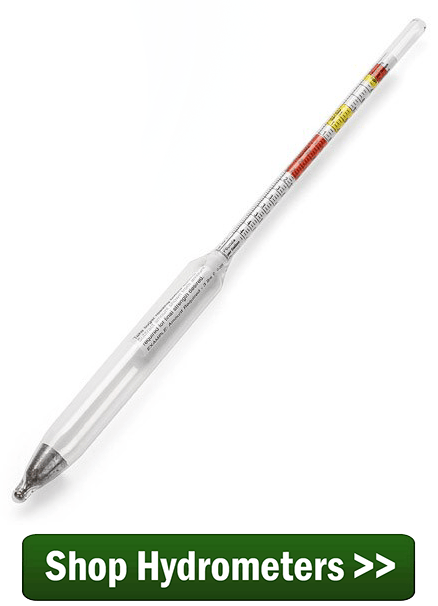
verify with a gravity
hydrometer that the wine has actually completed its
fermentation. It is possible that the bubbles you are
experiencing are from a slight, but still...
Hi
EC,
How long can finished wine be stored in gallon glass
jugs?
Gabe
-----------
Dear Gabe,
There is nothing unique to homemade grape wine that makes it
spoil any faster or keep any better than commercially made wines.
As long as the homemade grape wine is treated
properly, it will keep just as long and as good as wines
stored in glass jugs that you purchase at the store.
What does treated properly actually mean?
- It means your wine must be dosed with sulfites, and
- Your glass jugs must be...
Hi.
Can you give me any information on how barometric pressure would
affect the fluid level in an air lock. Some days they show
negative pressure and a day or two later they are making bubbles
again. I can't tell if fermentation is done or not.
Thank you
Jerry
----------
Hello Jerry,
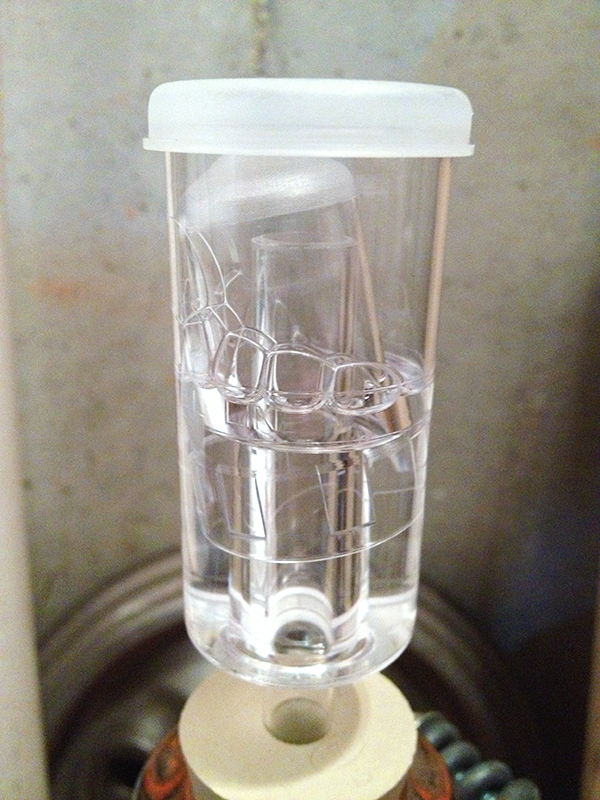
An air-lock is what
seals the outside world from your wine during and
after fermentation. It is a barrier that allows
gases from the fermentation to escape while
keeping little bugs and other intruders out.
You attach...
Greetings,
My son gave me a 5 gallon oak barrel as a personalized
wine gift. I have a batch of wine that I would like to put in
the oak barrel and let it age a bit. Do I finish the wine
(use bentonite) and then put it in the barrel or should it go into
the barrel now, let it age for a period of time then finish and
bottle it?
Thanks,
David
----------
Dear David,
Thanks for the great question, and way to go
son! An oak
wine barrel is really one of the better wine making
gifts you can receive as...
Dear
EC Kraus:
I just started my first batch of wine using the "California
Connoisseur Necessities Box" (Chianti option). In 6 days,
I will be racking the wine.
When racking into glass jugs, I understand that I need to leave behind the sediment created during the primary fermentation. However, the plastic fermenter is NOT transparent and it will be difficult to see when I will start encountering the sediment as I drain the wine in to my glass wine carboy. Naturally, I would like to get as much...
Read More » »
At
the very center of wine making is the process of
fermentation. Fermentation occurs because the yeast
want to consume the sugars in a wine must. As a result
the sugars are converted into both alcohol and CO2 gas by the
fermentation. Normally as winemakers, we are concerned about the
alcohol, but in this post we are going to change
directions and talk a little about the gas.Almost all of the CO2 produced during a fermentation dissipates into the air and goes away very quickly, but not all of...Read More » »
One
of the long, ongoing discussions in the world of home wine making
is, "should I age my wine in bulk or in
bottles?"What Exactly Is Bulk Aging?
Bulk aging refers to storing the wine in something similar to a glass water bottle. Home wine makers refer to them as carboys or demijohns. It's important to have a container with a neck of some sort so that the head-space, or air gap, can be mitigated as the bottle becomes full. It is usually sealed airtight with either a rubber stopper or cork...Read More » »
Hi,
I have a question. This is day 5 of fermentation for my
apple wine. It's been in plastic fermenters. I just
siphoned it into a couple of glass jugs and put the
air-locks on. How long should it take for the air-locks
to start peculating. I do not see any signs of the wine
brewing. If it doesn't start in 24 hours does that
mean my wine is bad?Thanks, Bill
__________
Hello Bill,
Before we can really answer your question we need to get a hydrometer reading of the wine must. It is very possible...Read More » »
Good
Morning,
I recently made some apple wine. It is now in secondary
fermentation, and still looks very “milky”. There seems to be a lot
of tiny fruit particulate in suspension. Very little seems to be
settling out. I will need to rack this wine next weekend, what
should I do to clarify the wine?
Ken H.
__________
Hello Ken,
The reason your wine is still milky or cloudy is because it is
still fermenting. You will not see any signs of clearing until the
fermentation has completed, or its activity...
Hello,
I bought two
wine making kits from you that makes 6 gallons (30 bottles).
Last night we bottled the the first wine and got 25 bottles. Is
this about right considering you do lose some during racking?
Approximately how much waste do you normally have due to sediments
in the bottom?
Mary M.
__________
Dear Mary,
While there will be some waste, there should be nothing close to
the five bottles you lost on your first batch. You should be losing
no more than one bottle when making wine from...
Hello:
I am getting ready to start my first batch of wine from
concentrate. I am a little confused about the sanitizing process
for large pieces of equipment. The directions say to dissolve so
much sanitizing stuff to one gallon of water. Does this mean a
gallon will do the job? With a 6 gallon tuft tank or a 6 gallon
glass carboy, for example, do you pour the gallon in the container
and slosh it around? If so for how long? Directions say to soak
corks from 5 to 10 minutes. Small items such as...
Hi
E.C.,
I'm making my first wine ever with
your starter kit and my own wild grapes. I have your plastic
fermenter that came with the kit, but I bought one of your
glass jugs for
secondary. I just started the secondary fermentation and I am
not sure if I should continue to stir daily. I assume once the air
lock is on I should just leave it alone?
Thanks,
Luke
----------
Dear Luke,
Once all the wild grape pulp has been removed from the
fermentation, there is no need to stir the...
Part
of learning how to make your own wine is mastering the process of
racking. Racking means to transfer the wine or must from one
fermenter to the next so as to leave any sediment behind. This
process usually needs to be done once or twice with the wine
brewing and at least once before you bottle.
If you have one of our plastic
fermenters with a faucet at the bottom, racking is simple.
Just attach our 3/8" vinyl hose to the spigot and turn it on with
the hose leading to the next fermenter. The...
Here's a question from a customer who has essentially aged
his wine in bulk for a few months. He wants to know if he should be
adding sodium metabisulfite at this time.
----------
Fellow Winemakers,
Can I add sodium
metabisulfite to my wine now?
I have 25 gallon of grape wine in 5 gallon glass jugs that I made
in September of 2009 filled to the top no air space to stop
bacterial infection can I add sodium metabisulfite before
I rack the wine? and how long should I wait before I rack the
wine? I...