
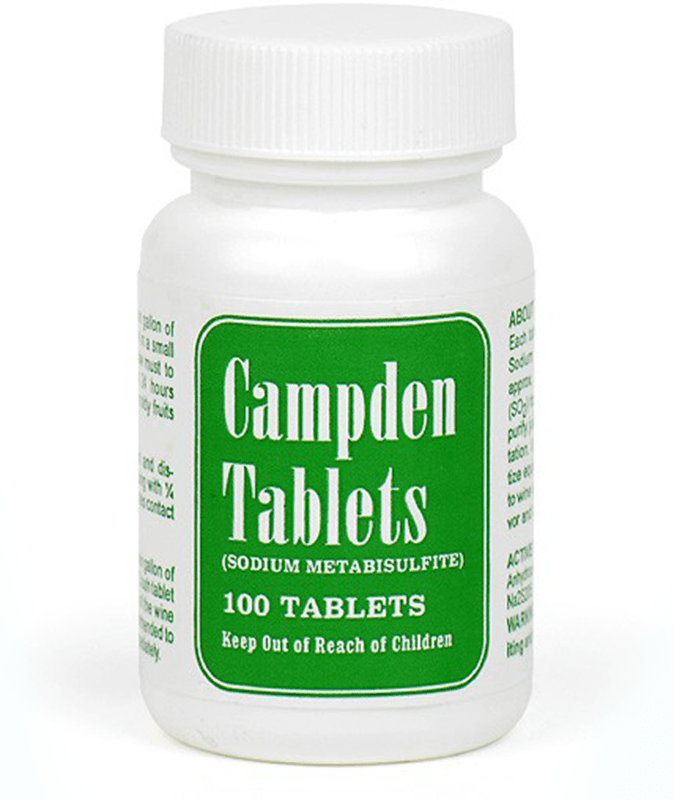
 One of the most commonly used ingredients in home wine making are Campden tablets. You will find them in almost any of the wine making recipes you will use; talked about in almost any of the wine making books you will read; and called into action by just about any of the homemade wine instructions you will follow.
What Do Campden Tablets Do?
The original reason Campden tablets were used in wine making was to keep the wine from spoiling after it had been bottled. By adding these tablets at bottling time, you could virtually eliminate any chance of your wine falling victim to mold, bacteria and other foreign enemies.
Since their introduction into wine making, Campden tablets have also become routinely used for sterilizing the juice prior to fermentation. By adding Campden tablets a day before adding your wine yeast, you can start your fermentation with a clean slate, so to speak. All the unwanted micro organisms will be gone.
Some home winemakers also use Campden tablets with water to create a sanitizing solution. This solution will safely sanitize fermenters, air-lock, stirring spoons, hoses and all the other pieces of equipment that may come into contact with the wine must.
What Campden Tablets Don’t Do?
Many beginning winemakers believe that Campden tablets are a magic pill of sorts. One that can instantaneously stop a wine fermentation dead in its tracks. While it is true that Campden tablets can bring a fermentation to its knees for a period of time, it is also true that these fermentations will usually gather themselves back up and eventually overcome the effects of the tablets. The result is a continued fermentation – sometimes after the wine has been bottled.
Truth is, Campden tablets are not designed to stop a fermentation and never have been. Using them for that purpose can get you into all kinds of trouble. There is really no ingredient that can be safely used by itself to assuredly stop a fermentation.
What Are Campden Tablets?
Simply put, Campden tablets are metabisulfite. When you add a tablet to the wine you are adding sulfites to the wine. Most Campden tablets consist of potassium metabisulfite, but some are made with sodium metabisulfite.
How Are Campden Tablets Used?
Their use is fairly straight-forward. You add one tablet to each gallon of wine must 24 hour prior to adding the wine yeast – before the fermentation. Then you add one table per gallon just before bottling.
The Campden tablets must first be crushed and dissolved in a small amount of the wine or water. This mix is then stirred thoroughly into the rest of the batch.
You can use the Campden tablets to create a sanitizing solution by crushing up 4 tablets into a quart of water. This can be used as a sanitizing rinse, or you can pour it into a fermentation container and allow the fumes to sanitize the entire insides.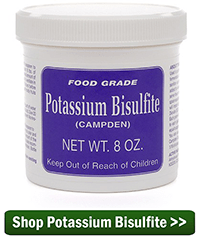
As An Alternative To The Campden Tablet…
You can use potassium metabisulfite or sodium metabisulfite in the form of a granulated powder. The advantages are: you don’t have to crush it up; and it is cheaper. The disadvantage is you have to measure out the dosage, which is 1/16 teaspoon per tablet.
—–
Ed Kraus is a 3rd generation home brewer/winemaker and has been an owner of E. C. Kraus since 1999. He has been helping individuals make better wine and beer for over 25 years.
I drop one campden tablet into to one gallon of wine and it dissolves it self, is there any need to crush it
I have had them sit on the bottom and not disolve right away and effect the yeast I added the next day. Stuck frement time.. I cruxh them and mix in water before adding now.
the aim is for the sulfite to disperse all over and prevent bacteria from growing. If the tablet dissolves by itself, saves some trouble of crushing it.
Hi John I mistakenly didn’t crush my tablet on starting my wine, and when adding my yeast I didn’t see anything foaming up. Is my wine still good? I do notice some bubbles after a couple days. Is it ok?
Sure do enjoy your tips on wine making…U R giving me the "itch" to get back at it again Thanks Gene
If Campden Tablets are so essential to add just prior to bottling, why doesn’t the manufacturers of high end wine kits (RJ Spagnol. Vineco Showcase etc.) specify that in their instructions?
it is mainly a precautionary step to ensure no contamination.
If you do not wash your hands after pooping, and then eat, will you get sick? Likely no, but do you want to risk it?
May be they don’t want thier brand associated with additives,at the risk of telling readers what they already know sulphur dioxide in the correct quantities maintains the flavour and prevents spoilage and has been used in winemaking scince Roman times. I think that it is advisable otherwise you would have to make your wine with the most scrupulous attention to hygiene and sterilization.I am not an expert but I urge those who are complete beginners to home wine making to use campden tablets
Elmer, Thanks for the great question. I can’t speak RJ Spagnol because we do not carry that brand, but all the juice kits we do carry have you add packet #3 of potassium metabisulfite after degassing the wine. In addition to this, they state that if you plan on storing your wine for longer than 6 months to add another 1/4 teaspoon of your own potassium metabisulfite before bottling. This last part is not listed within the steps themselves, but as additional information on the directions sheet. This is true for all the juice kits we offer. Personally we always recommend to our customers that they add the sulfites before bottling. There’s just no reason not to.
1/4 tsp per bottle or gal?
Judy, if you are asking what the dosage is when adding sulfites to your wine, it is 1/16 teaspoon or one crushed tablet for each gallon of wine.
What is the difference between potassium metabifulfide & sodium metabifulfide? Which to use in wine making? Thanks in advance.
LilyMar, Actually, the main difference between sodium metabisulfite and potassium metabisulfite is that one will leave residual amounts of sodium in the wine and the other will leave some potassium. For more information, please see the article link posted below.
A Simple Guide To Metabisulfites
https://blog.eckraus.com/a-simple-guide-to-metabisulfites
HELP!! We bottled our homemade grape wine 3 months ago. Opened a bottle and it foamed in the glass. We can’t remember if we added potassium metabisulfite before bottling. Can I empty bottles in primary fermenter stir back and forth and rebottle. Should I add a camden tablet or potassium metabisulfite. Thanks
Hi Julia,
As listed in this article, Campden tablets and potassium metabisulfate are one and the same (some Campden tablets are sodium metabisulfate and have the same effect, differences are in the chemical makeup).
Disclaimer: I’m a home brewer like yourself and by no means a professional. The rest of my comment is based off what info I’ve read and my experiences.
As far as the foaming wine, that *may* be a normal effect of the wine you made. I’ve noticed some wines tend to have a bit of “fizz” to them which may be a product of carbonation.
Since you made homemade grape wine, there will be natural yeasts and microbes that were present in the must prior to pitching your yeast unless you used Campden tablets in your must ~24 hours prior to pitching the yeast. These may or may not be harmful to your wine, but can produce different flavors as your wine fermented.
If you wanted to open every bottle and pour it back into a fermenter, I would think that would be fine as long as you sterilize everything first. Keep in mind that doing this will add some oxygen to your wine. Campden tablets could be added in a 1 crushed tablet or 1/16 tsp to 1gal wine ratio.
If you truly have a renewed fermentation happening in the bottles, they can explode or blow the cork off (yeah, don’t ask how I know that…!). Look up “yeast crashing methods” which will suggest how to kill any yeast present and eliminate the chance of renewed fermentation.
Good luck!
I had a similar issue as I resweetened the wine back up. Camden suppressed the ferment for a couple months but a bottle blew up ,. Others foamed up when I dumped them in primary I use the correct stuff now and not Camden at bottling .
Pretty sure you need potassium sorbate if you’re back sweetening like that.
Julia, at this point you need to put the wine back into a fermenter and let it finish fermenting. Once the fermentation has completed (you can verify this with a hydrometer), then you can add potassium metabisulfite to the wine and bottle. It is important that you understand that sulfites of any kind will not consistently stop a fermentation. For this reason we do not recommend that you rely on it to do so.
My home made grape wine was ruby red and beautifully clear. Just before leaving on vacation I noticed a very small amount of mold. As a precaution, I added 5 crushed and dissolved camden tablets to the 5 galllon carboy. That was in February and to date it is still cloudy. Will it clear by itself or is there something else I can do?
I actually had that happen to me. Sorry I have no link – but the info I uncovered (if I remember correctly) said that the binder in the tablets may sometimes cause some cloudiness, whereas the regular K-meta doesn’t have a binding agent, so it won’t. I had to wait for my red to settle out AGAIN after adding campden tablets. So basically it got a little longer (about a month) bulk aging, hehehe. I now only use campden before fermentation and K-meta every time after that, so it doesn’t cloud up on me. YMMV (your mileage may vary) Just wait for it to clear.
Also, everything else the CS person said is correct. You may have a restarted fermentation. In either case – looks like you’re waiting it out. LOL
Happy Vinting!
Walt, can you provide a link for K-meta?
Thanks
I have read on other wine making sites that you should add camden tablets before fermentation and again on the first, third and fifth racking, and so on and again just before bottling. Is this necessary? I have been making wine for a year and have always done this.
Jojo, if you are making wine from fresh fruits you want to add Campden tablets before fermentation. You will want to add Campden tablets, again, after the fermentation. And then finally, once more, right before bottling.
What if sulfites are a problem? I find I am sensitive to lots of things and sulfites are one of them. Is there an option for sulfite free homemade wines?
ttobin, unfortunately sulfites play a significant role in keeping the wine from spoiling. While it is possible to make wine without any sulfites added, your risk for spoilage is dramatically increased. So much so, that it would be best stored under refrigeration. It is important to note that the fermentation, itself, produces significant sulfites… up to 25% of what is required to keep a wine stable. Because of this a truely "sulfite free" wine is impossible.
My wine (Red) comes in a 6 gal pail. I run a small hose through a 1/4 hole in the top of the pail to a glass jug of water. It’s not long and the water starts bubbling. After a month of this bubbling (burpping), I rack the wine into a glass car boy. It continues to burp for as much as a year, is this normal? When should I add campden tablets, how many for 5 gal and do I crush and mix with the wine to make a solution and then pour it into the wine? What does adding the tablets do for my wine? Thanks, John
JL, the time table of your wine making process is somewhat off. The bulk of the fermentation should be done in about 5 to 7 days. This is also when your first racking should be done in to the carboy. If the fermentation was healthy it should be complete in two week or less. Once the fermentation has completed it is time to rack again then add Campden Tablets — one per gallon. This will help to protect the wine from oxidation and spoilage. Once the wine has had plenty of time to clear, usually 1 to 2 months, the wine should be racked again. Another dose of Campden Tablets should be added and you can bottle the wine. The fact that your fermentations are going on for months indicates that the environment is not correct for the wine yeast to perform the fermentation. I would suggest that you take a look at the article, "The Top Ten Reasons For Fermenation Failure" that is listed on our website: http://www.eckraus.com/wine-making-failure/
I am a first time wine maker and really appreciate your site! I started my first attempt last night with a blackberry fruit wine base and followed the wine making process on the can. One of the steps is to add 1 Campden Tablet for each gallon of water which I did to later re-read to see I was supposed to wait until week 3 or 4. I have read on some sites the high level of sodium will stop the fermentation process. I have not added my yeast yet. Is there something I can do to save my wine and make sure it ferments?
Amy, the amount of sodium that are in the Campden Tablets is not of any concern to the fermentation. The amount is much too small the affect a fermentation in any way. The issue at hand is the sulfite, the active ingredient of the Campden Tablet. One tablet per gallon will kill a portion of the wine yeast and hinder the fermentation if action is not taken. Fortunately, the solution is simple. All you need to do is allow the sulfite to dissipate from the wine. Simply leave the fermenter uncovered for a 24 hour period. After this, it will be safe to add the wine yeast. You will still want to add more Campden Tablets in the future as directed.
I want to "preserve" fresh squeezed orange, grapefruit and lemon juice without freezing and was told campden tablets would act as a preservative without refrigeration. However, the person who told me this said her orange juice turned to wine but she thought it was because her bottles were plastic. Can I preserve fresh juice by simply adding campden tablets or is that a myth?
Rita, yes you can use Campden tablets to preserve your juices. Add one crushed Campden tablet per gallon of juice. Then seal the container up in a timely manner. The suflite from the Campden tablets will dissipate into the air if given enough time. Secondly, make sure the containers are full, with no head-space. And third, if you do not plan on making wine with the juice, you can also add Potassium Sorbate. This will keep any microbes that the Campden misses from multiplying and causing spoilage.
All of this hold true for mead, I wonder?
Stephen, everything you’ve read above does apply to Mead as well.
If you use 1 Campden tablet per gallon how much potassium sorbate would be required to mix with the Campden per gallon.
Diego, it is important to understand that Campden tablets are completely independent of potassium sorbate, so regardless if you Campden tablets or not, you will want to add 1/4 teaspoon of potassium sorbate to each gallon of wine. If you add sugar at bottling time to sweeten the wine, then you will want to use 1/2 teaspoon of potassium sorbate per gallon.
how long ? can you leave wine in a carboy after fermentation .
Jimmy, I would not leave the wine more than two or three days after the fermentation completes. You usually want to get the wine off the sediment reasonably quick. This is because the wine can develop off-flavors if left on the sediment for longer periods of time.
Hi…..I’ve made a batch of cider….its now in a large sealed bucket and is fermenting away BUT everywhere I’ve read it says you should add a campden tablet 24 hours before you add your yeast which I didn’t do this time or the previous time – I added it at the end after I’d strained the cider and 24 hours before the cider was bottled – will my cider still be safe to drink? I left it 4 weeks to ferment and settle last time then I strained off the sediment 2/3 times before adding the tablet and bottling……the cider was then kept in the fridge.
I have been making homemade wine for more than 50 years, and I have not yet used Campden tablets or any other form of sulfite.
My wine does not spoil for at least 2 years – in y own opinion most of my wines have best taste when about 2 years old. My blackberry wine is still good up to 5 years. Why does everyone think that one MUST use sulfites to make good wine?
Thank you Ed.
Fee, the fact that you had a successful fermentation would indicate that everything is fine with the cider. A healthy fermentation will keep down any molds or bacteria from growing. You add Campden tablets after the fermentation and before bottling so it is being protected after the fermentation just fine.
I am making my first ever batch of wine. I used a red muscadine grape added water and sugar as the recipe indicated. It then said to add 1 crushed campden tablet per gallon and yeast nutrient to the must. Befor I added the campden I had beautiful color to my juices after the campden was added the juice became clear. Is this normal?
Leanna, the true color of the wine is not going to become apparent until after the fermentation. The skin of the grapes is were the color lies. The color is extracted from the skins during the first 3 to 5 days of fermentation. If you noticed a drop out of color before the fermentation, it was not because of the Campden tablets — they have no ability to do such a thing — but rather from the loose tannins from the grapes dropping out. They and other sources of color pigmentation will be saturated into the wine once the fermentation gets started.
I racked a grape wine after the first fermentation and let it set for a three weeks. I noticed a thin white film forming on top of the wine so I added two crushed campden tablets, it is a one gallon carboy. the top half of the wine in the carboy turned hazy. I have waited 24 hours and it has not cleared. What could be the problem.
Dave, I am fearful that the white film (bacteria) is what’s causing the haze in the wine. It would have been better to rack the wine away from the film before adding the Campden tablets. At this point, your best option is to wait. My guess is that the haziness will rise to the top again, and then you can rack the wine into a clean jug.
Just started my first ever batch of wine. Muscadine wine. It has just finished sitting for 24 hours. I went to add the yeast and there is brownish jelly looking floaties in it. I added pectic enzyme, yeast nutrient, and 5 camden tablets crushed before placing it in my wine making spot. 5 gallons of wine is what I am making. The smell of it is leaning towards sour grapes. I did sterilize all equipment prior to mixing. Is that brown jelly stuff normal?
I would strain the must to remove the jelly substance and then proceed with adding your yeast. As CS stated, sounds like some of the inner grape.
April, I would examine the jelly looking stuff more closely, but my guess is it is some of the inner flesh portion of the grapes. But, I can’t rule out some foreign matter either that came with the grapes. It is up to you to investigate further because what you are saying is not normal.
I’d like to use campden to sterilize a small amount of juice for topping up. I doubt that I will be able to accurately divide a tablet smaller than into quarters. Is it harmful to use a higher concentration than the usual one tab per gallon, for this purpose? Thanks!
Molly, for the portion of the entire batch we are talking about, it would not matter if you added a little more than what is standard. Just do the best you can.
I am the owner of a small tea company,I make fruit tea and am searching for ways to preserve my product’s shelf life for commercial purposes. Assuming that if camden is good for juices, it should also be good to use in tea as well, shouldn’t it? If I choose to just use a combination of potassium sorbate and potassium
metabisulfite, would that increase the shelf life. How much of each to use per gallon of tea and would there be a need to add more of each before bottling as you would with wine? How long will the tea last? In consuming these sulfites, are there any dangers or health risk? Are these sulfites considered one of the 7 or 8 allergens?
I have not added campden. Fermentation started 2 days ago. and I have around 40 days in my hand to add campden tablets. But I am not getting campden tablets , any alternatives of it? If i get it how much quantity should i add in 2 gallons
Rajat, if you do not have Campden tablets the only things you could use would be either potassium metabisulfite or sodium metabisulfite. I you can not get either of these, the only thing I would suggest is to be very clean with all of your winemaking equipment and wait the 40 days before bottling so that you can add Campden tablets right before bottling. You only need to add 1 tablet per gallon of wine.
Hi should campdem tablets be added when i rack my secondry for the first time, or can i add half of one every time i rack, the wine is made from abiu, cheers fro australia
David, you should not add Campden tablets to your wine if it is still fermenting. If you are not sure, you can use a hydrometer to help you determine when the fermentation is complete or not. Some winemakers will add Campden tablets once the fermentation is complete, but most do not. It depends on if you plan on bottling the wine as soon as it is clear or if you plan on bulk aging the wine for a while. Here is another blog article that should help to clear this up a little more:
Using Campden Tablets: The How, When & Why
http://blog.eckraus.com/wine-making-tricks-and-tips/using-campden-tablets
I added 1 campden tablet by mistake to my gallon jar before pouring my still fermenting wine into it, will I need to throw the wine away or keep it in the jar for a longer period so the fermentation can restart..
Mick, there is no reason the throw the wine out. You just need to get the wine going again. If the fermentation has come to a complete stop, splash it around a bit so as to get rid of the SO2 gas from the Campden tablet; put it back in the gallon jug; and add a fresh packet of wine yeast. If the wine is still fermenting along, just be patient.
put in our own blueberry wine in Jan, 2014.we have racked it once.Now it is July and the wine is still fermenting and very sweet.What can we do?
Mabel, the fermentation should have been done within 2 weeks time. It sounds like your wine never fermented, or fermented very little. I would suggest that you go over the following information. It is possible that the Campden tablets killed your yeast if you put them in at the same time.
Top 10 Reasons For Fermentation Failure
http://www.eckraus.com/wine-making-failure/
Hey I got a great video on replacing Campden tablets with potassium metabisulfite solution here: https://www.youtube.com/watch?v=CayBv64erfs
June, the amount of water you put with the yeast will have no effect on it one way or the other. What will affect the yeast is the temperature of the water and the length of time it is allowed to sit at that temperature. It is important that the re-hydration directions of the yeast packet be followed precisely. Not doing so will result in killing too many yeast cells to properly start a fermentation. If you feel this may be the case, I would suggest adding another packet of wine yeast, only this time sprinkle it directly onto the wine must and stir it in.
I recently started a batch of Hard cider, I have it fermenting in a 5 gal plastic carboy (Blue water jug) and I want to rack it into a 6 gal glass carboy do I have to add juice to top it off or just leave an air gap in the carboy? I assume I will get about 4 gallons will this be too much air room?
Tim, as long as it is still fermenting the excess space will not be an issue because the CO2 coming off the fermentation will protect the wine. However, as soon as the fermentation completes you do need to address the excess space. The following article will discuss this in more detail as well as advise you how to deal with the excess space.
Topping Up
http://www.eckraus.com/wine-making-topping-up
Not sure if this question relates to Campden tablets or not but my wine is bubbling and I have not added the yeast yet. Should it be doing this and should I wait till it stops before adding the yeast?
Brandon, if you are making your wine from fresh fruit as opposed to a concentrate, etc., it is possible that it started fermenting with the natural yeast. There is also a smaller chance that a bacteria is starting to ferment. In either case, you want to add sulfites such as Campden tablets to stop this activity. Then wait 24 hours with the fermenter covered with nothing more than a thin towel. You want the sulfite gases to dissipate. After 24 hours add a wine yeast. This will help to insure that you have a healthy fermentation.
I added my campden tabs right after I added my yeast. is this going to alter the outcome of my batch of wine. Should I pour it out and start over?
These are the steps I followed:
1. Crushed fresh grapes into a plastic barrel
2. Allowed the must (or rather the grapes/peels/pulps) to rise from above the juices (about 6 days)
3. Strained the juices from the barrel and placed into another plastic barrel. Pressed the peels/pulps and added that to the virgin juices removed earlier.
4. Immediately added 1tablet per gal.
5. Waited about 7 days and racked the "wine", adding another batch of campden tablets @1per gal.
I have no idea if it finished fermenting.
My original thought was that the "wild" yeasts from the grapes themselves would take care of the fermenting in that 1 weeks time.
Then by adding the campden tablets, they would kill that yeast.
After the first racking (in removing it from the sediment on the bottom) I added more tablets to ensure that any bad yeast would be dead. I did leave only a paper towel over the opening for 24 hrs after adding the tablets.
I now have an airlock on the container..and it is still "burping". I imagine that it is still fermenting.
What is going on? and what should I do to salvage any possible waste?
Thank you ~
BLU, I do not see where you have a problem. I am amazed that the wild yeast is still able to ferment at all with the sulfite additions that have been made. Normally, this would easily kill any wild yeast. To expect a fermentation to be done in 6 or 7 days is not realistic. It happens all the time, but there is no guaranteed that that’s how a fermentation will go. At this point you need to do nothing. Let the fermentation continue on. Once the bubbling "completely" stop, you absolutely need to check it with a hydrometer to confirm that the fermentation has completed and not "stuck". From there you want to give the wine plenty of time to clear. Hope this information helps you out.
i made my first batch of wine , and i have done secondary fermantation but i am not getting sodium or potassium metabisulphite. so if i don’t put sodium or potassium metabisulphite and bottle the wine . is my wine will get spoil?
Glad your responding in the future as it’s September 12th here in America.
I used to ferment in open containers but most times we lost to microbes and spoilage. We moved to closed stainless tanks and haven’t needed any sulfites pre-fermentation. I will use after my extended fermentation with whole clusters – red that is. Once the fermentation stops (tomorrow), I will reduce the lid down To the must removing any air. The CO2 is removing any air now.
nongothung, not using sulfites in your wine is not a guarantee that a wine is going to spoil, although the chances will be much higher. What it does guarantee is that the wine will start loose it’s color and freshness sooner than a wine that has had sulfites added. You may notice the wine starting to turn color some through oxidation, and eventually, you may notice the wine start to slowly spoil or turn to vinegar.
Racked my 7 gallon carboy filled with Allicante/Moscato juice and with tasted fizzy and a bit of an off taste. Carboy was in garage wrapped in a moving blanket and winter temps were near zero for extended period of time. Is the wine salvageable or am I S.O.L.?
Cochise, if the wine is fizzy then it more than likely never finished fermenting last year. Now, since the temperatures are getting warmer, the fermentation has probably started back up to finish off the sugars that still remain in the wine. Your best course of action at this point is to let the fermentation finish. Keep the fermentation between 70 and 75°F. Once the fermentation has completed: give it time to clear up (a week or two) and then rack it off the sediment. At that point you will be able to bottle it. If you are not using a hydrometer I would suggest that you one. This will help you to know if you fermentation has, in fact, completed when it stops. The funny taste will probably go away one it has cleared, but I do not know for sure because I do not know what you are tasting for sure.
I added the yeast to the must 15 hours after adding a campden tablet rather than waiting 24 hours. Will that cause a problem?
Delwboy, unfortunately, there is no way to know for sure if it will cause a problem or not. My best advise is to wait to see if the fermentation activity starts. If you do not see any activity within 36 hours, i would try adding a new packet of yeast.
Help! My husband is making home-made cider. He introduced the yeast after 24 hours and has just realised he never put in the campden tablets before introducing the yeast. He’s worried this will affect the taste of the cider and spoil it. Do we need to start again?
Claire, at this point what I would do is wait until the fermentation completes and then add the campden tablets to purify the juice.
Forgot To Add Campden Tablets
http://www.eckraus.com/blog/i-forgot-to-add-campden-tablets-to-my-wine
I picked some late season muscadines and they are extremely ripe. some where they collapsed in my fingers picking them but very fragrant. I cleaned my carboy with camden tab s, etc but I didn’t wash the muscadines rather hoping for more wild yeast to be present as I didn’t do reg grape juice as well. I am hearing all sorts of things on Lactobacillus and Acetobacter maybe spoiling it. I did add some monch packet yeast with the muscadine strained juice. It is absolutely jumping now. Bubbling away. Should I add campden tabs and then add more monch. yeast to reactivate it ot just wait.
Terra, yes you can add the campden tablet now if you want. You will need to leave the fermenter open covered with just a towel for 24 hour before adding the new packet of yeast.
Hi , have I just spoiled my wine by adding one Camden tablet straight into boiling water , was ment to be cold water ? I noticed a green tinge on the must as soon as I did this. Is it still ok?
Susan, I am sure your wine will be fine. It is fine to dissolve the campden tablets in warm water. However, you should wait until the water cools before adding it to the must.
I am making a 6 gallon batch of muscadine wine. I completed the primary fermentation and racked to a carboy with airlock 9 days ago. I’ve had no movement whatsoever on the air lock from day one. Not sure where to go from here. Should I uncap it and add yeast or go ahead and rack again and let it clear?
Keith, since about 70 percent of the fermentation completes in the primary stage, it is not uncommon to not have much activity in the airlock during the secondary stage. By this time the fermentation has slowed down and not as much gas is coming of the fermentation to cause much airlock activity. It is also possible that the fermentation has already completed. If you haven’t already done so, I would take a new hydrometer reading. If the reading does not show the fermentation to be complete, take another reading a few days later. If there is movement, you just need to wait for it to complete. If it remains the same, you have a stuck fermentation. To fix a stuck fermentation, you need to know what caused it to become stuck before you can correct it. The article below will cover the 10 most common causes of a stuck fermentation.
Top Ten Reasons For Fermentation Failure
http://www.eckraus.com/wine-making-failure
I am making my first three batches of 1-gallon wine and mead. My mead is made with white grape concentrate and my (red) wine is a concentrate. I have racked twice and both have just begun clearing. My question: I am not up to the neck of the glass gallon container. What is the best thing for me to add to raise the level in my jar to reduce surface area? Thanks for any suggestions.
Bart, while most wine recipes will allow for topping up with water, the following article will provide you with other solutions to deal with excess head space.
Topping Up Your Wine
http://www.eckraus.com/wine-making-topping-up
i haven’t crushed my Camden tablet will it still work? I put it in the demijohn whole
Regards
Bev
Bev, over time I am sure the tablets will dissolve. You will want to make sure that they are mixed in all throughout the wine.
I used some spring water to make a batch of rhubarb wine a little over a week ago. It is still fermenting. I did add camden tablets prior to adding the yeast. In the meantime, I had drank some of the water and ended up with giardia. I am wondering if the fermentation process will kill the parasite or if I need to dump the batch. Would love to hear your thoughts.
Jenn, we are sorry that happened to you. Unfortunately, we just do not have the information and cannot tell you for certain that the fermentation process will kill the parasite.
I am making cider. do i have to add artificial sweeteners if i dont want my cider so dry or can i add more sugar after fermenting completely?
Norbert, the correct method of sweetening your cider is to let it finish fermentation, clear and be ready to bottle. You will add potassium sorbate to prevent re-fermentation and sweeten however you prefer to your preference. The following article will discuss this in more detail.
Making Sweet Wines
http://www.eckraus.com/wine-making-sweet
Several hours after adding campden tablets some of the containers of wine must have a greenish tinge. Serious or not
Michael, we do not believe this is a serious issue. We also do not think the campden tablets caused this to occur but if that is the case, it should be temporary.
Dear all,
I made red wine from 100% of grape juice bought it from the supermarket , do I need to use Campden tablet before fermentation and after fermentation ?
Do I need to use it when I rack it to another container for clearfiy the wine ?
Before I bottling, how to use Campden tablet ? Crushed 1 tables per us gallon and mix it well with the wine,
Is this correct ?
Once I put the Campden tablet before bottling, do I need to wait some time let’s say 24 hours before bottling or bottling immediately?
Thamer, if you are using a juice or concentrate that you purchased at the supermarket, you do not need to add campden tablets prior to adding the yeast. When they are added prior to fermentation it is because you are making wine from fresh produce and they will destroy any bacteria or wild yeast that may be present on the fruit. The article posted below will discuss any additional times the campden tablets are needed.
When Do I Add Campden Tablets
http://www.eckraus.com/blog/add-campden-tablets-to-wine
Am I supposed to add campden tablets to my wine before it goes into a 30 gallon oak barrel for about half a year? I am a bit confused… because I added MLF after I pressed and it has been a few weeks. Should I wait out to finish malo before and campden before barrel? I will be keeping it topped up and purged with co2 when filling. Thank you so much!
Nick, yes you want to wait until the malolactic fermentation before adding any sulfites because the culture is very sensitive to sulfites. Once the maloactic fermentation completes you do need to add campden tablets while it is bulk aging in the barrel.
i am making blackberry wine and rinsed my gallon jug out with hot water added the juice then sugar used hydrometer was9.4 is that allright for red wine its fermenting steady
Ed, I have been using a solution of K-metabisulphite and a sulphatiser prior to bottling kit-made wines. Do you think the residue from the solution that stays on the inside of the bottle is equal to that of a campden tablet? I do not like to add extra sulphites to my wine because some people are sensitive, even allergic, to them. I have been doing this since 2002 and have never experienced any wine going bad, and some of them are, let’s say, well aged now. Thanks for your articles and keep them coming.
Bob, unfortunately sanitizing your bottles with sulfites is not the same as adding them directly to the wine.
Hi. I am making my first batch of muscadine wine. I used a recipe from a blog that didn’t suggest campden tablets. It wasn’t until I’d already put the wine in the carboy to ferment for 6-8 weeks that I started reading on other sites about the tablets. Is it too late to add the tablets?
Brandy, you can add the campden tablets now but since they will probably damage the yeast, wait the 24 hours and add a new packet of yeast.
I am just curious how reliable campden tablets are at sanitizing must in general. For example, if i were to make a mead and wanted to flavor it in primary with an herbal tea that I made. If I were worried about any possibility of contamination in the tea that I added to the must, can i rely on campden tablets to sanitize my must? Mainly, can campden tablets sanitize any must? Of course I would still be as careful as possible to sanitize everything on my own, but just to have a piece of mind that I have nothing to worry about. Can they be a fix all for sanitizing any must??? Thank you very much!
Ben, by adding one tablet per gallon of must, the campden tablets will kill any bacteria that could contaminate your wine.
I have crushed some apples to make cider and the recipe I was following said to put a campden tablet into the must and then wait 48 hrs before pitching the yeast. I am now ready to pitch the yeast but fermentation, perhaps of wild yeast has begun. Should I use another tablet or just progress as instructed?
Phil, you do not mention how many gallons of cider you were treating. The dosage of campden tablets is one per gallon. If you have more than one gallon, one tablet is not enough to do the job and I would add the appropriate amount before adding the yeast.
Hi. I did a mistake. I added one teaspoon metabisulphite per gallon grape juice.what can i do? Thank you
Mahmood, what you will need to do is rack the wine in a splashing manner to try to get the sulfites to leave the wine. The article posted below will discuss this in more detail.
Too Much Sulfite
http://blog.eckraus.com/too-much-sulfite-wine-homemade
I used 5 campden tablets prior to adding 1118 yeast, let sit for 24 hours. About a week later I racked into a carboy with an airlock. About 2 weeks after that I racked the 5 gallons of wine again while adding 5 more campden tablets. At this point all bubbling/fermintation appears to have stopped and the wine is cloudy where as before it was clear. What happened and what do I do?
Paul, the first thing that I would do is take a hydrometer reading to make sure the fermentation is complete. If not, the cloudiness could just be fermentation starting up again.
If it is complete, I would take a look at the following article for possible causes of a cloudy wine.
Wine Turned Cloudy
http://blog.eckraus.com/white-wine-turned-cloudy
Just started our first batch of red wine using grape from our vine! The recipe says to crush grapes, add water and sugar and yeast. After a week strain into fermentation jars. I don’t have any yeast until tomorrow so at the moment the grapes are in a bucket with sugar and water. Should I add a campdwn tablet tonight and wait 24hr before adding the yeast??
Emma, you can add the campden tablets, seal up the fermenter and it will keep the juice until you get the yeast. Then you will open it up, cover it with a towel and wait 24 hours before adding the yeast.
This is the first time I’m using Campden tab for my red wine that I make from grapes, I added 1 tablet per gallon of crushed grape and after 24 hrs I added the yeast, in just 6 days the SG has dropped from 1.095 to below 1, instantly I rack the must and added another campden tab per gallon, taste and color are great, my question is if I rack it two more times and bottle it in one month, should I add another dose of campden at the bottling?
Sasan, the only other dose of campden tablets you need to add is at bottling time. The article posted below will discuss this in more detail.
When Do I Add Campden Tablets
https://blog.eckraus.com/add-campden-tablets-to-wine
Many thanks
Bert, I do not believe the addition of the Campden Tablets and cloudiness are related. There is nothing about Campden Tablets that cause cloudiness. It is more likely that the wine has started to ferment again as warmer weather came upon us. I would suggest that you take a hydrometer reading to confirm all the all the sugars have fermented and your fermentation is complete. If you find that renewed fermentation is the cause, your only choice is to be patient.
If I put in camden tabs, put lid on bucket with airlock, and wait 24 hours am I at any danger? I then pitch the yeast and reseal? I keep reading I need to keep the bucket open for 24 hours with the camden tabs. Never done that. Can I keep doing it the way I usually do?
chucktowndcroz, campden tablets can destroy the yeast. This is why you instructed to simply cover the fermenter with a thin towel and wait 24 hours. This will allow the sulfites to leave the juice. If you use the lid and airlock during this time, the sulfites are trapped and not allowed to leave the juice therefore your yeast can be damaged. This is actually one of the most common cause of fermentation failure.
Sealing Fermenter After Adding Sulfites
https://eckraus.com/wine-making-stuck-4
https://eckraus.com/wine-making-stuck-4
I am making rhubarb wine, My juice was a nice rosy red. When I added the campden tablets prior to starting the fermentation process, the red disappeared. Is this normal?
Bob, on occasion the sulfites can temporarily change the color of the wine but it is only temporary.
Thank you. Yes, after a couple days fermenting, the color is back. I am learning a lot from your website.
I’ve just made my first ever batch of pear cider, put the juice into a demi John and accidentally added the camden tablet at the same time as the yeast.. I was rushing and not following the instructions properly. Have I ruined it or will it be ok? Thanks
Anna, the wine is not ruined but the yeast may have been destroyed. All you need to do is add another packet of yeast.
I made a muscadine 10% abv wine. After racking once it cleared to a nice glassy finish. It was a nice medium pink wine (sg<1 and clear). I racked it to add the 1 Camden tablet per gallon, plus sorbate in order to bottle. As soon as the pink wine mixed with the sugar, sorbate and Camden tablet, it turned light orange, no more pink. I went ahead and bottled it and weeks later, still no pink.
I racked some into a glass with some sugar to back sweeten and it remained pink.
Why did the Camden tablet strip the color?
Both sulfite and potassium sorbate can temporarily drop color from your wine. This happens on rare occasions and is usually an indication that the acidity level of your wine is too low. I would recommend testing your wine with an acid test kit and add acid blend as needed. Magically, just putting the wine in the right acidic range can bring the color back.
Acid Test Kit
https://eckraus.com/acid-test-kit/
Acid Blend
https://eckraus.com/acid-blend/
HELP! It is our first time making wine from a bucket of wine juice (Italian cabernet). The blog with winemaking instructions that we used stated to put the campden tablet in and then let sit for 4 hours uncovered, then add yeast.
We made two mistakes. 1) We crushed the campden tablet and used 1/4 teaspoon instead of 1 tablet per gallon=6. 2) We added the yeast only 4 hours after the 1/4 teaspoon was added. We didn’t pick up on the mistake until today (We did all of this Monday evening and it is now Wednesday morning. Yesterday the lid was loosely set on and we stirred it 2 X.)
Can this juice be saved? Can we start over again? What do you recommend doing?
Thank you SO MUCH for any and all insight on this!
Kayla, normally you want to wait 24 hours after adding sultfite leaving the fermenter cover with a towel before adding yeast. Each campden tablet is 1/16 teaspoon so 1/4 teaspoon in 6-gallons is not too much. All that happened was most or all of the yeast was probably destroyed. You just need to allow the sulfites to leave and add another packet of yeast.
is it necessary to use yeast when making wine with campden tablets? or can i still wild ferment with this method?
The Campden tablets are added to kill any wild mold and bacteria that may be with the juice. Unfortunately, it will easily kill any wine yeast, as well. Domesticated wine yeast has been acclimated to sulfites to a minor degree. Sulfite is what the Campden tablets provide, so it will thrive even though Campden tablets have been used. However, you do need to wait 24 hours before adding wine yeast if Campden tablets have been used. Keep the wine covered with no more than a thin clothe during this waiting period. Then add the yeast.
Hello,
I will add campden tablets to my wine today before bottling. Is it safe to drink a bottle immediately right after?
Diana, Drinking wine right after you add campden tablets is not harmful, but for the quality of the wine you will want to let it age.
So the whole reason I came here was to see if one campden tablet is better than the other. Sodium or potassium?
Ben, The first thing to understand is that all three of these wine making ingredients do the same thing: Campden tablets, sodium metabisulfite and potassium metabisulfite, they all add sulfites to a solution. Whether it be wine or water the result is the same. Regardless of which of the three you use, the result is the same. Sulfites are being added to the liquid. The article posted below will discuss this in more detail.
A Simple Guide To Metabisulfites
https://blog.eckraus.com/a-simple-guide-to-metabisulfites
I am getting ready to go from primary to secondary fermentation, Should I add campden, 1 tab per gallon, at the time I go to secondary or should I let the wine ferment without campden and add to secondary 24 hours prior to bottling?
Process Operator, you do not want to add any additional campden tablets until the fermentation is complete. Sulfites can interfere with the completion of the fermentation. Typically, you add them prior to fermentation, after fermentation completes and again at bottling time. The article posted below will discuss this in more detail.
When Do I Add Campden Tablets
https://blog.eckraus.com/add-campden-tablets-to-wine
Thank you, I am holding off until 24 hours prior to bottling.
Question: Can super kleer and campden be added to wine (24-48 hours before bottling) at the same time or will this create off notes with taste and aroma?
I assume you are ask is it going to be okay because you did not use Campden Tablets. The good news is you have a fermentation successfully started. This is important in protecting the wine. So you are okay… so far. However, I would strongly recommend you get some Campden Tablets to add to the wine right before bottling and to use with future batches.
Thanks for the blog.
I started a batch of apricot wine last night. I crushed the campden tablet and mixed it in. Unfortunately, I sealed the primary fermenter to move it and forgot to take the lid off. I left it sealed overnight or for about 12 hours. I unsealed it this morning and noticed the color was a little darker than my last batch. Should I throw the batch out OR maybe wait 24 hours to be sure it dissipates OR just proceed as normal adding the yeast this evening?
Dudley, putting the lid on the fermenter after adding campdens tablets should not affect the color. However, before adding the yeast, you do need to allow the sulfites to leave by leaving it covered with a towel for 24 hours.
I’ll start off by saying I am a beginner. I am making cherry wine and it’s been about a week or less since I started it, I sealed the lid after I put the Camden tablets in, and then added the yeast 24 hours later. I didn’t realize I wasn’t supposed to seal the lid at that point, and now my wine doesn’t seem like it’s bubbling/fermenting like it should. Is there something I should do at this point?
Stormy, more than likely the yeast was damaged by the trapped sulfites. I would take the lid off for a few hours and then add a new packet of yeast.
Sealing Fermenter After Adding Sulfites
https://eckraus.com/wine-making-stuck-4
I harvested 15 gallons of juice from my orchard 3 days ago and I am just now getting ready to deal with it—the juice has been sitting in 3 5 gallon carboys for 3 days. Wild fermentation has begun…IS IT TOO LATE TO TRY AND USE THE CAMPDEN TABLETS TO KILL OFF EVERYTHING?? Help!
Jeff, it is not too late to try to kill the wild yeast and bacteria. Go ahead and add the campden tablets.
My gosh! So much to learn and I began with too many suggestions from people. I had a 5 gal container for my must of muscadine grapes. Pitched my yeast (no campden tabs) sat and gassed for 3 wks. Strained, racked in carboy And set for another 3 wks gassing away. Racked again and dissolved campden tabs. And now it’s sitting. I tasted it before the tablets and it will need extra sweetening (I do have the potassium sorbate). I realize now as I’ve been reading here, I probably didn’t do it all correctly and in a proper order, what are my next steps?
Irene, Welcome to home wine making! Once the fermentation completes, you then wait for it to clear. Once it has completely cleared, you will rack it off the sediment, add your potassium sorbate and sweetener, add another does of campden tablets and bottle. Below is an article that goes over the steps to wine making.
7 Steps To Wine Wine Making
https://eckraus.com/wine-making-steps/
I wanted to o know if I put to much water in the yeast will it still work and I put the towel over it for 24 hour then the air lock will the grape still make or can I still add more yeast into the patch to get it going. Or should I just start all.over. Thank u
Ryan, you did not ruin your wine by any means, but you probably kill most or all of the yeast you added. There is a simple remedy. Wait the 24 hours and add another pack of yeast. If you do not have another pack of yeast, seal the must up air-tight keeping the sulfites from the Campden tablets trapped. The must will keep fine this way for a week or better. Once you get the yeast, unseal the lid for 24 hours and then added it. If you added the Campden tablets 24 hours ago already but have no yeast, add another half-dose seal it up until you get the yeast. Wait the 24 hours, uncovered, and add it.
I have Pot. Meta and Sodium Meta. Can you give me info on how they differ? I also have Pot. Sorbate…what is it for?
Carolyn, potassum metabisulfite, sodium metabisulfite and campden tablets are all interchangeable. Really the only difference is potassium metabisulfite is potassium based and campden tablets and soduim metabisulfite are sodium based. I am including the link to an article that will discuss this topic in more detail.
A Simple Guide To Metabisulfites
http://www.eckraus.com/blog/a-simple-guide-to-metabisulfites
Potassium sorbate is a wine stabilizer that you add to keep the wine from re-fermnting if you sweeten the wine.
Potassium Sorbate
http://www.eckraus.com/blog/what-does-potassium-sorbate-do-for-my-wine